



JOHN Lennon was a member of The Beatles before the Fab Four broke up in 1970 – although they had ceased to function as a team for some time. The breakup was legally formalised in 1974 after years of disputes.
Lennon then started releasing music with Yoko Ono under the Plastic Ono Band name including the anti-war song “Give Peace a Chance” and, what was to become a global peace anthem, “Imagine” in 1971. That was also the year he moved to New York and the Nixon administration launched a three year battle to deport him, using a 1968 cannabis conviction in England as the pretext.
In 1980 he and Ono produced the album “Double Fantasy” which signalled a new era of music for the couple. Three weeks after the album was released, John Lennon was shot dead outside his apartment home in New York City by Mark David Chapman, described in the press at the time as “a deranged fan”. Chapman waited at the scene and immediately confessed to the police.
The conspiracy theorists had a field day and, although the US Government was concerned about Lennon’s anti-Vietnam opposition, there is no evidence to support the claims that the government or the FBI was involved in Lennon’s murder. The assassination was a single act by a mentally disturbed man.
Several books have been written about the murder of John Lennon which attracted global condemnation. In Fenton Bresler’s book “Who Killed John Lennon” published in 1989, his theories point to the killer being a programmed assassin controlled by the CIA through drugs and hypnosis. There is no evidence to support this theory.
Another theory is that Chapman was pushed to the limit by Lennon’s comment that he was “more popular than Jesus” and a long history of unstable depression, fantasies and general mental state was the driving force behind the killing. There is no doubt that the US Government had John Lennon on their radar but that surveillance ceased years before this murder.
John Lennon was inducted into the Rock and Roll Hall of Fame twice – once as a member of the Beatles in 1988 and then posthumously as a solo artist in 1994. It seems strange that Lennon’s anti-war activism was not protected under the First Amendment of the American constitution on the freedom of speech. He did not present a “clear and present danger” one of the tests applied to looking at the First Amendment, although he was seen by some members of the government as a person who was leading young people astray and opposing the illegal war in Vietnam.
The war produced many powerful protest songs which were influential, class and deeply personal and yet their performers never received the surveillance Lennon did. Creedence Clearwater Revival, Bob Dylan, the Doors, Joan Baez and Pete Seeger all produced songs looking at the futility of war and, as the war in Vietnam escalated, the voices of dissent grew louder and louder, which led to the withdrawal of American troops in 1972/73. A song by The Animals “We Gotta Get Out of this Place” was popular with American troops who wanted to go home but, on returning to the USA, many faced abuse in a nation at war with itself. It appears in the lyrics of Bruce Springsteen’s “Born in the USA” – a powerful anthem, about the plight of veterans and how the country treated its soldiers. That legacy continues to this day – in 2025 almost 52,000 veterans were being assisted to find stable homes. To provide some balance, the number of homeless people counted on one single night in January 2025 was almost 746,000 from a population of over 341 million.
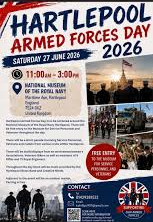
In the UK, the figures are based on estimates and official counts which say that the number of veterans in need of urgent accommodation range from 2,180 to over 6,000. Sometimes saying “Thank you for your service” seems as futile as was the clapping during the Covid 19 pandemic. Ex-servicemen and women, who stepped up to defend our country, many making the ultimate sacrifice, need to be supported after they leave the service. The Royal British Legion is one of the key organisations that help ex-service people and their families and you can help also by visiting www.britishlegion.org.uk or supporting the Hartlepool Branch of the British Legion at the Armed Forces Day on 27th June at the National Museum of the Royal Navy in what promises to be a fantastic day for all the family with a parade, brass band, displays, market stalls and free museum entry for all serving personnel and veterans.

Author: John
Author of Around The World In 80 Years