


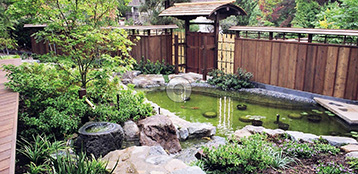
So if you want to create your little haven of oriental ambience, where do you start?
Despite their apparent simplicity, Japanese gardens are the hardest to copy as their roots lie in religious philosophies, their rocks and plants all have a meaning and there is great significance in where they are placed.
Such gardens reflect a deeply spiritual nation with a great reverence for nature, as the tea ceremony, arched bridges and pagodas are embedded in their social and religious life.
Tea gardens comprise a series of settings which induce different states of spiritual contemplation.
You can gain inspiration just from admiring the detail of surfaces and structures used in Japanese gardens, such as raked gravel floors, bamboo and calming water features.
And it is plants like the stunning Japanese maple (Acer palmatum) and the beautifully structured bonsai that really capture the spirit of the Far East.
Without going into philosophical details of how you should achieve the optimum energy flows, it might be best to start with the raw materials and plants which may enable you to achieve what you are looking for.
Japanese traditional garden elements include water, carp, bridges, moss, stepping stones, bamboo, clipped evergreens, maples, cherry trees and stone lanterns.
Rocks are carefully placed near pools for harmony, while wind chimes and flowing water often add a soothing sound to the scene.
Even if you only have a small garden, Japanese maples are excellent trees for containers as there are a number of slow-growing, smaller varieties which can spend their lives in pots if they are repotted when necessary.
Given some shelter, they can be grown in ordinary well-drained soil with the addition of compost.
They need to be planted in full sun or part-shade and can easily be grown in the shadow of other trees as long as the earth isn’t full of roots.
The beauty of these elegant trees is in the leaf colour in the different seasons as well as their seeming fragility, especially among species such as Acer palmatum atropurpureum, which turns from plum to rich red in autumn.
Other trees common to such tranquil gardens include Japanese flowering cherries (Prunus serrulata).
The tall, narrow Prunus serrulata ‘Amanogawa’ has pale pink flowers in spring and its foliage turns gold and deep orange in autumn.
Many oriental gardens are also richly planted with azaleas and ferns, irises and willows amid winding paths, clipped trees and little hills.
If you have a pond, give it some soft colour and structure with Japanese water iris (Iris laevigata), which are dense, clump-forming plants with sword-shaped leaves, bearing blue, purple or mauve flowers in early summer.
If you want a water feature, a shishi odoshi makes striking use out of natural materials such as bamboo and rocks to create a simple, subtle feature.
And for winter colour you can’t beat Japanese rush (Acorus gramineus ‘Ogon’), which produces fan-shaped gold and lime-striped foliage, which is great for ground cover but can also be planted in winter containers.

Author: Jonny
Author of Gardening Life!