

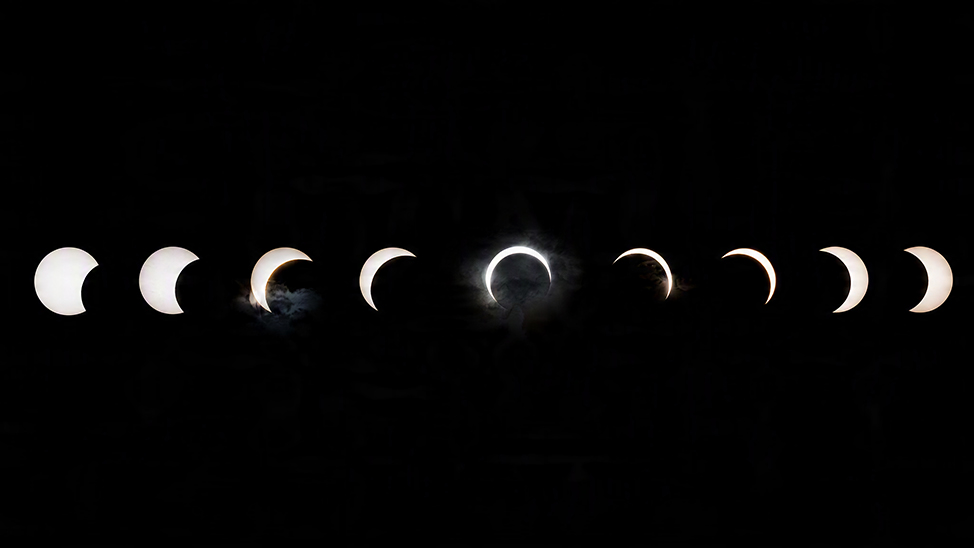
Hartlepool Marina provided the backdrop for a remarkable sequence of images as I managed to capture the changing face of the Sun during the dramatic, partial solar eclipse.
From the first bite taken out of the Sun to the dramatic moment when the Moon covered around 90 per cent of its disc, nine separate photographs have been brought together to create a striking montage of one of the year’s most memorable celestial events.
The images, taken from the Hartlepool Marina area, record the eclipse, from left to right, as the Moon steadily moved across the face of the Sun before beginning its journey away again.
However, getting the impressive sequence was far from straightforward.
Clouds threatened to spoil the spectacle at exactly the wrong moment, leaving me fearing that the most dramatic stages of the eclipse might disappear behind a blanket of grey.
The clouds came over just at the wrong time – and I feared I was going to miss the action but patience prevailed and I just about got all the stages that I wanted.
When the clouds finally gave way, the opportunity was seized!
The photographs were taken using a Canon 5D Mark II fitted with a Sigma 70-200mm lens. Without a dedicated specialist solar filter, I improvised with equipment already available – using five neutral-density (ND) filters stacked together to dramatically reduce the amount of light reaching the camera.
The camera was also set to f/22, its smallest aperture, with an extremely fast shutter speed of 1/8000th of a second. The combination was intended to keep the intense sunlight from overwhelming the camera sensor and allowed me to capture the changing shape of the eclipsed Sun.
The effort paid off!
As the Moon moved further across the Sun, the atmosphere around Hartlepool began to change. At maximum eclipse, when roughly 90 per cent of the Sun was obscured locally, the scene took on an eerie quality.
There was a definite silence – and everything went a lot darker and surreal.
Hartlepool experienced the eclipse as a partial event, with the maximum occurring at around 7.07pm, when the eclipse reached approximately 91.5 per cent magnitude locally.
Although the August 12 eclipse was part of a total solar eclipse globally, totality was not visible from the UK. For observers in Hartlepool, it was nevertheless an unusually deep partial eclipse, making the event particularly memorable.
For myself, however, the occasion carried an even greater sense of significance. The next total solar eclipse visible from the United Kingdom is not due until September 23, 2090 — a date far beyond the lifetime of most people alive today.
I won’t be around for the next total eclipse in the UK in 2090, so I wanted to make sure that I captured this one. Hopefully I can travel abroad to maybe capture one.
The resulting nine-frame montage is more than simply a record of an astronomical event. It captures the progression of the eclipse, the changing light over Hartlepool and the persistence required to photograph a fleeting moment when the weather threatened to intervene.
For a few minutes, the Moon, Sun and clouds combined to make the Marina feel like a very different place — and thanks to a little patience, the moment was preserved.
The nine separate images were processed in Adobe Photoshop, then joined together in a montage.
